sat suite question viewer
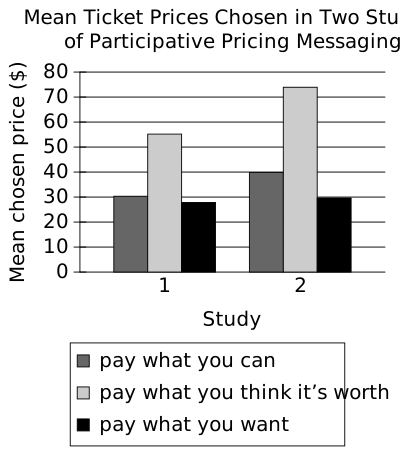
- For each data category, the following bars are shown:
- pay what you can
- pay what you think it’s worth
- pay what you want
- The Mean chosen price data for the 2 categories are as follows:
- Study 1:
- pay what you can: $30.33
- pay what you think it’s worth: $55.19
- pay what you want: $27.85
- Study 2:
- pay what you can: $39.83
- pay what you think it’s worth: $73.93
- pay what you want: $29.64
- Study 1:
Participative pricing, in which purchasers choose the prices they pay for products, can enable sellers to capitalize on the heterogeneous values consumers assign to the same goods and services, but doing so requires careful messaging. Annie Peng Cui and Jennifer Wiggins recruited 171 participants (ages 18–60) online for an initial study and 83 students (ages 18–31) at a state university for a second study to test the effect of three different messages—“pay what you can,” “pay what you think it’s worth,” and “pay what you want”—on how much participants would pay for concert tickets. Their results illustrate both the heterogeneity of consumer valuations and how sellers can benefit by prompting consumers to consider their own valuations: blank
Which choice most effectively uses data from the graph to complete the text?
Explanation
Choice C is the best answer because it most effectively uses data from the graph to complete the text about the effect of messaging on participative pricing. The graph shows mean ticket prices chosen by participants in response to three messages across two studies: Study 1, which the text indicates was conducted with an age-diverse group recruited online, and Study 2, which was conducted with student participants. The graph indicates that in the "pay what you think it’s worth" condition, the mean price of the concert tickets in Study 2 was about $74, which is greater than the mean price of about $55 in Study 1. In other words, when participants were asked to consider their valuation of the tickets, the response was heterogeneous, or mixed. Moreover, according to the graph, both Study 1 and Study 2 show higher prices for the tickets under the "pay what you think it’s worth" condition than they do under both the "pay what you can" and the "pay what you want" conditions. That is, the data suggest that both groups of participants named higher prices when considering the value of the tickets than when considering either what they could afford or wanted to pay, a finding that supports the idea that sellers can benefit when prompting consumers to consider their own valuations when they choose prices.
Choice A is incorrect because it contradicts information in the graph. Although the graph shows that students in Study 2 assigned a higher value to the tickets than did the age-diverse group in Study 1, which would support the idea that consumer valuations were heterogeneous, the graph shows that in the "pay what you can" (i.e., what you can afford) condition, the students in Study 2 assigned a higher price (about $40), not a lower price, than the age-diverse group in Study 1 did (about $30). Moreover, even if it were true that the students had assigned a lower price in this condition, it wouldn’t support the result described in the text, only that the participants across the two studies had different ideas of what they can afford to pay. Choice B is incorrect. Although a finding that participants tended to choose prices that were closest to the actual ticket costs in the "pay what you think it’s worth" condition would support the idea that sellers benefit by prompting consumers to think about their own valuations (since it’s implied that sellers would lose money in the other conditions, where chosen prices were lower than the participants’ valuations), neither the text nor the graph addresses how any of the prices chosen by the study participants relate to the tickets’ actual market price. Choice D is incorrect. Although the wide variation in participant valuations would support the idea that consumer valuations tend to be heterogeneous, neither the text nor the graph provides any information from which to discern the relative levels of variance among the responses from participants in either study.